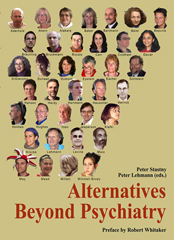
Contributions by Volkmar Aderhold, Laurie Ahern, Birgitta Alakare,
Karyn Baker, Ulrich Bartmann, Agnes Beier, Regina Bellion, Wilma
Boevink, Pat Bracken, Stefan Bräunling, Ludger Bruckmann,
Giuseppe Bucalo, Dorothea S. Buck-Zerchin, Sarah Carr, Tina Coldham,
Bhargavi Davar, Anne Marie DiGiacomo, Constance Dollwet, Jeanne
Dumont, Merinda Epstein, Sandra Escher, Jim Gottstein, Chris Hansen,
Geoff Hardy, Petra Hartmann, Alfred Hausotter, Michael Herrick,
Guy Holmes, Andrew Hughes, Theodor Itten, Maths Jesperson, Kristine
Jones, Hannelore Klafki, Miriam Krücke, Peter Lehmann, Bruce
E. Levine, Harold A. Maio, Rufus May, Shery Mead, Kate Millett,
Maryse Mitchell-Brody, David Oaks, Peter Rippmann, Marius Romme,
Marc Rufer, Gisela Sartori, Erich Schützendorf, Jaakko Seikkula,
Andy Smith, Zoran Solomun, Peter Stastny, Chris Stevenson, Dan
Taylor, Philip Thomas, Jan Wallcraft, David Webb, Uta Wehde, Scott
Welsch, Salma Yasmeen, Laura Ziegler and Ursula Zingler
Translations by Christine Holzhausen, Katy E. McNally
and Mary Murphy
Preface
The first question raised by a book titled "Alternatives
Beyond Psychiatry" is this: Why do we need alternatives?
What is wrong with the "care" that mainstream psychiatry
provides? While there are many answers to that question, first
and foremost we can look at one startling statistic, and that
is the rise in the number of people disabled by "mental illness"
over the past 50 years.
The modern drug-based paradigm of psychiatric care dates back
to 1954, when chlorpromazine was introduced as the first antipsychotic
medication. This, or so psychiatry would like us to believe, kicked
off a great leap forward in society's care of the "mentally
ill." Psychiatric researchers are said to have made great
strides in understanding the biological causes of mental disorders
and that has led to the development of ever better drugs for treating
them. Yet, here is what all this "progress" has wrought:
in the United States, the rate of the "disabled mentally
ill" has increased nearly six-fold in the past 50 years,
from 3.38 people per 1,000 population in 1955 to 19.69 people
per 1,000 population in 2003. Since the
introduction of Prozac (1) in 1987and this
was the first of the second-generation psychiatric drugs said
to be so better than the firstthe number of so-called disabled
mentally ill in the United States has been increasing at the rate
of 150,000 people per year, or 410 people newly disabled by "mental
illness" every day.
Other countries that have adopted a drug-based paradigm of care,
such as the U.K. and Australia, have also reported a great surge
in the number of people disabled by mental disorders in the past
50 years. This interesting fact leads to only one conclusion:
mainstream psychiatry's paradigm of care has failed. It has not
proven to be an approach that helps people struggling with mental
distress of some kinddepression, anxiety, manic thoughts,
psychosis, etc.recover and get on with their lives. Instead,
it has proven to be an approach that increases the likelihood
that such people will become chronically ill.
We desperately need to think of alternatives to that failed paradigm
of care. That is a big challenge, and yet the contributions in
this timely and much needed book all ultimately point to a common
starting point: if we want to help those struggling with their
minds, we can start by thinking of themas the Quakers did
when they rebelled against mainstream psychiatry in the late 1700s
and early 1800sas "brethren." Not as people with
"broken brains," but simply as people who are suffering.
From that conception, a whole world of "care" follows.
What does everyone need to stay well? Shelter, food, friendship,
and something meaningful to do with his or her time. Any society
that provides such care and support, along with a message of hopethat
people can recover from whatever mental distress they may be sufferingmakes
a good start at providing an effective alternative to psychiatry.
There are chapters in this book that tell of such programs. There
are proven alternatives to psychiatry, programs that have a track
record of helping people get better. And there are reports of
ways of coping with madness on an individual level. This book
hopefully will encourage many, many other such efforts to take
root and flourish.
Robert Whitaker (2)
Cambridge, MA
(1) Antidepressant, active ingredient
fluoxetine, marketed also as Auscap, Deprax, Eufor, Flexetor,
Fluohexal, Fluox, Fluoxebell, Fluoxetine, FXT, Lovan, Movox, Oxactin,
Plinzene, Psyquial, Sarafem, Veritina, Zactin; component of Cymbyax

(2) Robert Whitaker is a former newspaper
reporter who has written widely on the pharmaceutical industry
and on mental illness, and is the author of "Mad in America: Bad
Science, Bad Medicine and the Enduring Mistreatment of the Mentally
Ill". In this riveting social and medical history of madness in
America from the 17th century to today, Mr. Whitaker finds that
so-called schizophrenics in this country fare worse than patients
in the world's poorest countries. More
about Robert Whitaker
Introduction
"Alternatives Beyond Psychiatry" is a collection of
reports and approaches from non-, anti- and post-psychiatric everyday
life in different countries and provides an appraisal of individual
and organized alternatives and measures that point to a need for
structural change in the system. This is a book of practice and
ideas, more personal than generalized. It offers suggestions,
highlights contradictions and problems, and shows positive examples
and models but does not provide easy answers.
Our alternatives beyond psychiatry are far removed from the academic
remains of the '68 generation; nor are they a reform-oriented
variant of Italian psychiatry, social psychiatry or community
extensions of psychiatric institutions. Instead, alternatives
beyond psychiatry are truly innovative, initiated and carried
out by critical professionals and independent (ex-)users and survivors
of psychiatry, the real experts in the psychiatric domain, dedicated
to the right of self-determination, physical inviolability and
social support.
Alternatives beyond psychiatry originate from an undogmatic and
humanistic movement. Accordingly, the texts in this book are filled
with a contrarian spirit and the fundamental conviction that (1)
psychiatry, as a scientific discipline, cannot do justice to the
expectation of solving mental problems that are largely of a social
nature, (2) its propensity and practice to use force constitutes
a threat, and (3) its diagnostic methods obstruct the view of
the real problems of individuals.
Furthermore, the texts in this volume describe a commitment to
(1) developing adequate and effective assistance for people in
emotional difficulties, (2) safeguarding civil rights in treatment
on a par with 'normal' patients, (3) joining forces in cooperation
with other human rights and self-help groups, (4) use of alternative
and less toxic psychotropic substances and a ban of electroshock,
(5) new ways of living with madness and being differentwith
as much independence from institutions as possible, and (6) tolerance,
respect and appreciation of diversity at all levels of life.
This book has been published without any financial support from
sponsors. We have no connection to the pharmaceutical industry
and to organizations that are dependent on them, nor to Scientology
or other sects and dogmatists of whatever color. Beyond health,
nothing is more valuable than freedom and independence.
We would like to express our heartfelt thanks to the many supporters
who have provided valuable ideas, translated, corrected, and illustrated,
in particular Arno Hessling, Christine Holzhausen, Craig Newnes,
Darby Penney, David Oaks, Katy E. McNally, Kerstin Kempker, Martin
Urban, Mary Murphy, Paula Kempker, Pia Kempker, Rainer Kolenda,
Reinhard Wojke and Tricia R. Owsley.
Peter Stastny and Peter Lehmann
About the editors
Peter Stastny
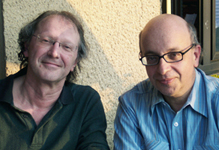
Peter Stastny (right) was born in Vienna, Austria, where he graduated
from medical school in 1976. Since 1978 he has been working and
residing in New York City. He is Associate Professor of Psychiatry
at the Albert Einstein College of Medicine in the Bronx and has
conducted several publically funded research projects in the area
of vocational rehabilitation, social support and self-help, in
collaboration with individuals who had survived personal crises
and psychiatric interventions. Currently, Dr. Stastny is working
on the development of alternative services that obviate psychiatric
intervention and offer autonomous paths towards recovery and full
integration. These activities have engendered a close collaboration
with the user-survivor movement, as manifested by joint research
projects, publications, service demonstrations, and community
work. He is a founding member of the International Network Toward
Alternatives and Recovery (INTAR). More
about Peter Stastny
Peter Lehmann (left). Born in Calw, Black Forest (Germany).
Education as a social-pedagogist. Living in Berlin. Founder and
editor, Peter Lehmann Publishing. From 1994 to 2000, board-member
of the German organization of (ex-)Users and Survivors of Psychiatry.
From 1997 to 2000, member of the Executive Committee of Mental
Health Europe, the European section of the World Federation for
Mental Health. From 1997 to 1999, Chair of the European Network
of (ex-)Users and Survivors of Psychiatry (ENUSP), since 20022004
Interim secretary of ENUSP, since 2004, ENUSP board member. Book
publications include Der
chemische Knebel Warum Psychiater Neuroleptika
verabreichen (The
Chemical Gag: Why Psychiatrists Administer Neuroleptics),
1986, reprint 2005; Schöne
neue Psychiatrie (Brave
New Psychiatry), 1996; Vol. 1: Wie
Chemie und Strom auf Geist und Psyche wirken (The Effects
of Chemistry and Electricity on the Human Mind and Psyche),
Vol. 2: Wie
Psychopharmaka den Körper verändern (How
Psychiatric Drugs Change the Body); Psychopharmaka
absetzen. Erfolgreiches Absetzen von Neuroleptika,
Antidepressiva, Lithium, Carbamazepin und Tranquilizern (2rd
ed. 2002; English edition: Coming
off Psychiatric Drugs: Successful Withdrawal from Neuroleptics,
Antidepressants, Lithium, Carbamazepine and Tranquilizers
[2004]; Italien edit. Liberarsi
dagli psicofarmaci. Riuscire con pieno successo a liberarsi
da neurolettici, antidepressivi, stabilizzante dell'umore, Ritalin
e tranquillanti and Βγαίνοντας
από τα ψυχοφάρμακa:
Εμπειρίες
επιτυχημένης
διακοπής
νευροληπτικών,
αντικαταθλιπτικών,
λιθίου, καρβαμαζεπίνης
και αγχολυτικών
[both in preparation for 2008]. More
about Peter Lehmann