 Back to Peter
Lehmann Publishing
Back to Peter
Lehmann Publishing
Peter Lehmann (not related to J. F. Lehmann)
"Progressive" Psychiatry
Publisher J. F. Lehmann as Promoter of Social Psychiatry under Fascism
Translated from the German by Peter Stastny
Who is familiar with the role played by J. F. Lehmann and his publishing house in the emergence of biologically orientated social psychiatry during German fascism and its further development in today's psychiatric system? What kind of ideology did this man stand for? Who were his friends? Which ideologies are still at work today? Many readers will not understand the significance of these questions. This is largely due to the work of most medical historians – the German psychologist Hans L. Siemen (1982, 1987) or the US-American psychiatrist Peter Breggin (1993b) are exceptions; normal historians placed the responsibility for the psychiatric horrors in Germany primarily in the lap of Adolf Hitler and his Nazis. In doing so they contributed little to expose the origins of biologically orientated social psychiatry and its catalytic effect and perhaps decisive precondition of the possibility for the Holocaust (Schmuhl, 2008, p. 33).
Social psychiatry
There is a difference between the eugenic orientation of early social-psychiatric efforts and its modern variant. Today, social psychiatry can be seen as an organisational structure of psychiatry, primarily dealing with early detection of micro-political deviance, "case"-registration and psychopharmacologic maintenance. By now, social psychiatry has shed the antisemitic views it espoused earlier. However, it has not abandoned its genetic premise, merely de-emphasising it in response to the current Zeitgeist. The belief in the determining influence of genetic factors is concealed in the "multifactorial" construct of "psychiatric illness".
The current state of the art of social psychiatric practice elevates the status of biochemical substances, in particular neuroleptic drugs (so called "antipsychotic medications"). This in spite of the fact that sufficient amounts of these substances used for long enough periods exert a sterilising influence during the course of their administration (P. Lehmann, 1993, pp. 91-172). Today's social psychiatry presents itself in a similarly progressive fashion, as it did during the eugenic era. An example of this is its critical attitude towards institutional psychiatry, which appears to reflect the current desire to cut costs. Beyond this, social psychiatry advocates the use of (newly developed) depot substances in order to "maintain" victims of psychiatry outside of institutions in supervised ("supportive") settings and to exploit them in self-help firms initiated by jobless former professionals.
In the meantime, these victims have remained essentially unchanged: persons with unsettling ways of living and thinking, who resist integration into living circumstances that are defined by market forces (and consumption) and whose despair, refusal to communicate, persecutory feelings, euphoria, death wishes, etc. have become subject to a systematic and "dear/expensive lack of understanding" (Kempker, 1991). When we look at the context in which the still widely respected Emil Kraepelin and his successors developed their program of social psychiatry, it becomes obvious why modern social psychiatry has concealed its racist, militaristic, antisemitic and nationalistic roots.
Social psychiatry, fascism and publishing
The confluence of psychiatry during the Weimar Republic with the National Socialist movement was pre-programmed. Wherever people started to promote psychiatric thinking, they also developed "social" forms of intervention, which were politically motivated: for example, sterilisation, castration and "euthanasia". This was not just a German or Swiss phenomenon. Britain and the USA, influenced by a rationalistic and paternalistic theory of science (Bergmann, 1988) were also affected by these developments. However, according to Breggin, at that time Germany was seen as the psychiatrically most progressive country (Breggin, 1974, p. 151). Marc Rufer, a physician from Zurich, pointed to the participation of Swiss psychiatrists like Eugen Bleuler and August Forel in the implementation of social-psychiatric crimes during the Nazi era (1991; 1993). In 1936, Eugen Bleuler had written:
"A not so easy question to be answered is whether it should be allowed to destroy lives objectively 'unworthy of living' without the expressed request of its bearers. (...) Even in cases of people with incurable mental illnesses, who suffer extremly from hallucinations or melancholic depressions and seem to be unfit to handle their affairs, it should be the right, and in serious cases even the duty of my medical colleagues to shorten the suffering – often for many years" (p. 206).
But beyond these efforts, one man deserves special mention for the dissemination and translation of social psychiatric ideas: Julius Friedrich Lehmann.
Long before 1933 psychiatrists systematically developed and disseminated powerful ideas in order to encourage their implementation among interest groups. However, the name J. F. Lehmann keeps coming up among the promoters of social psychiatric interests throughout its early years. Born in 1864 in Zurich as the fourth child of Dr Friedrich Lehmann and his wife Friederike (née Spatz), both of German origin, Julius opened a publishing house in 1890 in Munich, founded a medical book store and simultaneously became the editor of the Münchener Medizinische Wochenschrift (MMW; Munich Medical Weekly). J. F. Lehmann made sure that the unwritten rule of the MMW was observed that "no Jew could be admitted to the editorial board" (J. F. Lehmanns Verlag, 1940, p. 43). This clearly did not prevent any of the reputable "pure bred" doctors gracing this journal with their contributions. Not only did J. F. Lehmann consider his publications as "in the trenches", he also participated actively in the political struggle. He worked on and publicised several racist nationalistic organisations: The Thule Society, Society for Eugenics, Evangelic Association, German People's Protection and Resistance Troop, Free-corps von Epp and, finally, the National Socialist German Workers' Party (NSDAP). In a 1976 study, Professor Gary D. Stark from Arlington, Texas, finds that J. F. Lehmann was in the unique position to "co-ordinate the press and his personal influence within organisations with maximal impact – that is to connect personal, publicist and group – activities in a manner that no other racist ideologue could" (1976, column 314).
J. F. Lehmann's militaristic publications after the year 1906, such as the annually published Taschenbuch der Kriegsflotte (Paperback on Naval Armadas), gave him a substantial financial advantage. These warmongering works were largely bought up by the war ministry in Munich. In 1917, J.F. Lehmann issued the political pamphlet Deutschlands Erneuerung (Germany's Renewal), which sought to advance an ethnic rebirth "by sweeping away everything alien to our people, everything destructive and perfidious", and which expressed fervent opposition to "the Jewish Democratic predominance, the peace of Versailles, pacifism and Marxism". After World War I he advertised Im Felde unbesiegt (Unbeaten in the battle field) and Auf See unbesiegt (Unbeaten in naval war) as practitioners' "books for the waiting room".
But he also made money by publishing various medical texts. J.F. Lehmann's political and mercantile acumen contributed to the success of authors like the psychiatrist Alfred E. Hoche; a few years later (1920 in the S. Meiner publishing house in Leipzig) the same man co-authored (with Karl Binding) the portentous Die Freigabe der Vernichtung lebensunwerten Lebens (The Legalization of Destroying Unworthy Lives).
J. F. Lehmann's reactionary political views led to two brief imprisonments: first during the Munich Republic. Once free he joined the armed volunteer-corps, which took bloody revenge on the Spartacists and their real or alleged followers. During his second arrest he was charged with suspected sedition against the government of Kurt Eisner. Little deterred by his mild treatment from the law, he continued his interests. On 9 November 1923, he allowed Hitler to make use of his mansion to stage an insurrection attempt. Rudolf Hess, the subsequent deputy to the Führer, and 40 co-conspirators, used J.F. Lehmann's villa to abduct reigning Bavarian ministers. Hitler and J.F. Lehmann met during the early years of the "movement", when J.F. Lehmann seemed impressed by Hitler's leadership skills. In 1924, he published Hitler's rationale for the insurrection; in it Hitler demands the "destruction of every last Marxist for the sake of the fatherland" (Hitler, 1924). In 1933, the J.F. Lehmann house had the dubious privilege of publishing the Gesetz zur Verhütung erbkranken Nachwuchses (Law for the Prevention of Genetically Impaired Offspring) by Gütt, Rüdin and Ruttke; the Blutschutz- und Ehegesundheitsgesetz (Blood Protection and Marital Health Act) by Gütt, Linden and Massfeller; and the Richtlinien der Schwangerschaftsunterbrechung und Unfruchtbarmachung (Guidelines for abortion and infertility treatment) of the German Medical Association, which was distributed to all practitioners in Germany.
J. F. Lehmann and eugenics
Next to medical and militaristic/nationalistic works, eugenic literature formed the third main track of this publisher. In 1909, J. F. Lehmann published his first racist book, entitled Deutsche Rassepolitik und die Erziehung zu nationalem Ehrgefühl, by Eberhard Meinhold, a retired major, who advanced "farsighted proposals particularly relevant to our eastern politics". Under the leadership of the Swiss psychiatrist Ernst Rüdin, taught by Bleuler and Kraepelin, and Max von Gruber, a physician and proponent of the "breeding race", a eugenic section was instituted at the International Hygiene Exhibition of 1911 in Dresden. The catalogue bore the title: Fortpflanzung, Vererbung, Rassenhygiene (Reproduction, heredity, racial hygiene), and appeared in the J. F. Lehmann's publishing house, where it served as the foundation of its eugenic department. Rüdin as well as Ernst Bleuler were students of August Forel, a Swiss entomologist and Bleuler's predecessor in directing the famous Burghölzli madhouse in Zurich. Forel had achieved recognition among his colleagues by conducting the first sterilisation on psychiatric grounds in 1892 in his "clinic" (P. Lehmann, 1993, p. 30). On top of that, Forel was fond of pointing out that several leaders of the Paris Commune of 1871 ended up in Swiss mental institutions (Stelzner, 1919, p. 395).The interests of the men that appeared in the course of the years as friends, authors, supporters and co-militants of J. F. Lehmann, coincided with the spectrum of early social psychiatry. In 1935, his widow Melanie Lehmann remembers in her biography of her husband that in the years 1908 to 1911 he spent some time in the Swiss spa Davos, where he
"read and thought much about eugenics. Already then it was considered to require each marrying couple to obtain a health certificate in order to prevent the procreation of the physically or mentally ill. This movement which brought him together with Gruber, Kraepelin, Rüdin and Ploetz, and later on with Fritz Lenz, Baur and Fischer, soon aroused his lively interest" (1935, p. 36).In 1914, Gruber's young associate, Fritz Lenz, joined up with J.F. Lehmann to write a number of essays on eugenics and population control for Deutschlands Erneuerung (Germany's Renewal) and other journals published by them. In 1921, J. F. Lehmann issued a textbook prompted by Erwin Baur, the subsequent head of the Kaiser-Wilhelm-Institute for Research on Breeding, with contributions by the anthropologist Fischer and the eugenicist Lenz, which became the "standard work on German race research and eugenics" (Lenz, 1921). Bleuler was partly responsible for this success, since he qualified himself as a reliable co-militant by declaring opponents of World War I as "irresponsible agitators" and retaining them at Burghölzli. According to his assistant Johann Benedikt Jörger, these individuals were encouraged by the success of the 1917 Russian Revolution and became "insane apostles of peace and war resisters" by virtue of a "minor interlude of nature" (1918). And in 1931, Bleuler praised Lenz's book, Menschliche Erblichkeitslehre (Human heredity theory; Lenz, 1921) in a review:
"The practical suggestions of the author regarding this difficult subject consider humans as they are: their implementation is not impossible – they merely presuppose that the appreciation of the significance of eugenics will become much more widespread, towards which the book will surely contribute."
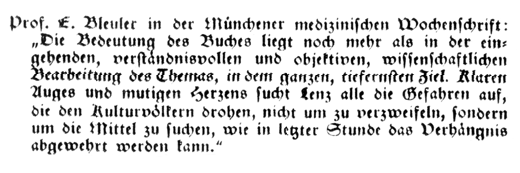
Bleuler had already supported Lenz's eugenic favour in a 1923 issue of the same magazine, warning about a "vulgarization of the race", as he praised the second edition of Lenz's Menschliche Auslese und Rassenhygiene in the following fashion:
"Lenz visits all the dangers that threaten cultured people with a clear and audacious eye, not to seek despair, but to realise that one has to fight for this matter of utmost value, and to search for the method by which the catastrophe can be averted in the last hour. And he knows the methods, actual methods, that can be realised, in spite of the sad dearth of racial pride in central Europe" (1923, p. 1489).
 Lenz
was further supported in his eugenic effusions by people like Rüdin,
Hoche, Muckermann, Ploetz and Bleuler. In 1922, J. F. Lehmann took over
the Archiv für Rassen- und Gesellschaftsbiologie founded in
1904 by the fanatic racist Alfred Ploetz as the sounding board of the
German Society for Eugenics. J.F. Lehmann's former associate and son-in-law
Otto Spatz, stated in 1940 (in the 50th anniversary issue), five years
after J.F. Lehmann's death, that Ploetz had many friends. Gruber, Kraepelin,
Rüdin, Fischer, Baur, Lenz, Hitler's future Secretary of the Interior,
Arthur Gütt, and of course, J. F. Lehmann himself, belonged to this
illustrious group (J. F. Lehmanns Verlag, 1940, p. 70). The magazine
Volk und Rasse (People and Race) appeared at J.F. Lehmann's for the
first time in 1926; before long Darré, the future Nazi Minister of
Agriculture, Gütt, Himmler and other luminaries joined the editorial
board.
Lenz
was further supported in his eugenic effusions by people like Rüdin,
Hoche, Muckermann, Ploetz and Bleuler. In 1922, J. F. Lehmann took over
the Archiv für Rassen- und Gesellschaftsbiologie founded in
1904 by the fanatic racist Alfred Ploetz as the sounding board of the
German Society for Eugenics. J.F. Lehmann's former associate and son-in-law
Otto Spatz, stated in 1940 (in the 50th anniversary issue), five years
after J.F. Lehmann's death, that Ploetz had many friends. Gruber, Kraepelin,
Rüdin, Fischer, Baur, Lenz, Hitler's future Secretary of the Interior,
Arthur Gütt, and of course, J. F. Lehmann himself, belonged to this
illustrious group (J. F. Lehmanns Verlag, 1940, p. 70). The magazine
Volk und Rasse (People and Race) appeared at J.F. Lehmann's for the
first time in 1926; before long Darré, the future Nazi Minister of
Agriculture, Gütt, Himmler and other luminaries joined the editorial
board.
Kraepelin, dictatorship and social psychiatry
In order to "reduce (the incidence of) madness", Gruber's collaborator Kraepelin began to recommend ruthless intervention in people's lives through dictatorship as early as 1918. In November 1920, he lectured to the Department of Genealogy and Demographics at the Psychiatric Research Institute in Munich, demanding a broadening of psychiatric practice in the following manner: to intervene against all possible forms of moral decay, against the lack of a clear and uniform direction in feeling, thinking and action and against "Internationalism" (Marxism). He termed this thrust "social psychiatry", a means of internal colonization. The necessity to develop a social psychiatry in Germany became apparent to psychiatrists in the wake of World War I: "mentally ill" soldiers (those with anti-war sentiments and lack of discipline) were deemed responsible for the military defeat and the "pauper's peace" of Versailles; "mentally ill" politicians like Erich Mühsam and Ernst Toller were frequently identified with the "debased" Jewish people and its "decadent forces of internationalism". According to these diagnosticians, they provided dear examples that foreboded an "epidemic" spread of such "mental illnesses" through the November Revolution and the Munich Republic of 1918-1919 (P. Lehmann, 1993, pp. 25-37).
Toller showed how little it takes to understand a psychiatrist like Kraepelin. In his biography Eine Jugend in Deutschland (A Youth in Germany) he described his time in Kraepelin's psychiatric clinic in 1918:
"You shouldn't make too many demands on doctors; if someone is clever, he soon understands the abracadabra of the good old wise women, and instead of red protective ribbons and magic spells, he delivers his own. He knows nothing of what is troubling people, and if he knows it, he doesn't understand it. The director of the psychiatric clinic is the famous Professor Kraepelin, who founded a league to defeat England in a Munich beer cellar.
– Sir, he snaps at me as I am brought before him, how dare you deny Germany's legitimate claims to power, this war will be won, Germany needs new living space, Belgium and the Baltic provinces, it is your fault that Paris has not yet been conquered; you are preventing the peace of victory; the enemy is England.
The Professor's face reddens, with the pathos of a manic assembly speaker he tries to convince me of the necessity of all-German politics, I learn that there are two kinds of sick people, the harmless ones lie in barred rooms without latches and are called madmen, the dangerous ones prove that hunger educates a people and form alliances to defeat England, they are allowed to lock up the harmless ones.
– We speak two languages, Professor, I say, I may understand your language, but my words are stranger to you than Chinese" (1979, pp. 106-107).
In 1919, Kraepelin's colleague Eugen Kahn raised the question how macro- and micro-political power relations might be protected from the influence of the "mentally ill". Kahn, who, incidentally, was charged with examining these obviously "uninsightful" revolutionary leaders, formulated this in J.F. Lehmann's MMW as follows:
"Before addressing this question we must admit that psychiatry has so far had practically no success in treating psychopathic tendencies therapeutically. We can imagine that early intervention of a pedagogic kind in specialized institutions might lead to a certain degree of rehabilitation among psychopaths, might stimulate the kind of social skills that can suppress their antisocial traits. Such institutions are therefore an absolute necessity" (p. 969).
This meant stimulating a preventative psychiatry which influences "mentally ill traits ... therapeutically" as much as possible, and prevents, in as much as such influence falls due to the severity of these "illnesses", their spread and the expression of "diseased traits" ("Entartung").
The various social psychiatric undertakings were soon noticed by the major German industries. For instance, Krupp von Bohlen und Halbach, following Kraepelin's suggestions, provided financial support for Rüdin's Research Institute (Labisch & Tennstedt, 1985, p. 169). Fritz Thyssen, another magnate who became interested In this field, followed Lenz's footsteps by becoming a member of the "Expert Commission on Population and Ethnic Politics" after 1933. Ploetz, Rüdin and Himmler were some of the other psychiatrically and eugenically steeped "expert" members of this group.
One of the eugenic measures, proposed by Lenz in 1921, was to focus on the "Jewish race", who he felt were biologically predetermined as "born actors, born orators and demagogues" that needed to be eliminated. Another measure, endorsed by Lenz and J.F. Lehmann to maintain a healthy "race", was the effort to seal Germany from all migrants of Eastern origin and to simultaneously spread the influence of "Germanic culture" eastward. In J.F. Lehmann's publication, Osteuropäische Zukunft (East European Future), which first appeared in 1916, he showed enthusiastic support for the "Nordic race", which included the German people, by expressing concern that unless appropriate measures were taken, it would be replaced by the "Turanic race", i.e., people from northern and central Asia. According to him such people, "live carelessly into the day and procreate themselves without concern. The Turanic race will control the fate of Europe, unless the Nordic race recognizes the danger and its perennial mission in the eleventh hour" (Lenz, 1917, p. 22). Lenz thought that the only realistic possibilities for the future of the German people were in Eastern Europe and that it would be better if a million Germans moved there every year, than if they were not born at all. One year later in Deutschlands Erneuerung he demanded the spread of German agricultural settlements towards the east, as "one of the most pressing survival issues for the German people".
Lenz's comrade, Bleuler, died in July 1939, shortly preceding the second wave of the "Nordic race" moving eastward, and before the industrial gassing of millions, first field-tested by psychiatrists on inmates (Lapon, 1986). Rüdin, the Chairman of the German Society of Neurologists and Psychiatrists, and his colleague Hans Roemer, praised Bleuler in the Allgemeine Zeitschrift für Psychiatrie und ihre Grenzgebiete (Journal of General Psychiatry and its Borderlands) for coining the term "schizophrenia", for his role in the "active and fruitful" exchange between German and Swiss psychiatry, and for his research accomplishments (1940).
Modern critique of social psychiatry
Today it is difficult to find an audience for critical remarks about social psychiatric positions, even when addressing left-leaning groups. Even the fact that modern social psychiatrists still practice electro-shock, a method developed by Mussolini's associate Ugo Cerletti in fascist Italy, which causes massive and irreversible brain damage (Breggin, 1979), does not diminish the progressive image of "critical" psychiatrists. They note a positive impact on "psychosis" from this electric trauma to the brain, in spite of "causing ictal damage to brain substance, even in the broadest sense of the term, which can be demonstrated in neuro-pathological (postmortem) studies. These must and can be accepted..." (Harlfinger & Schulte, 1967, p. 327).This statement was made by two psychiatrists in a book, which I discovered soon after finishing the first draft of this chapter. It was the Almanach der Psychiatrie und Neurologie (Almanac of Neurology and Psychiatry) published by J. F. Lehmann's publishing house in 1967. Other leading social psychiatrists like Wulff (1986, p. 15) and Dörner (both German) express a similar, at first seemingly critical, but finally supportive view of this barbaric method. In an illustration of Dörner's psychiatric writings and opinion, he recommends the uses of electroshock for a situation when a 'therapist' is "not capable to engage in a sufficiently effective therapeutic alliance" (Dörner & Plog, 1992, pp. 545), in order to transform "the psychically suffering temporarily into someone suffering from an organic brain syndrome (ibid., p. 546)", since ultimately "the patient almost always feels short-term relief and independence after ECT" (ibid.). The electroshocks distract his attention from his 'psychotic actions', in Dörner's words: "A threat to life and limb makes psychotic anxiety superfluous" (ibid.).
The minimal consequences of the psychiatric mass murders during German fascism are demonstrated by the uninterrupted activity of the J. F. Lehmann house beyond 1945 to this day, still used as a medium for institutional and social psychiatrists. For example, the same 1967 edition of the Almanac included an article by the T4 expert Friedrich Mauz, and a discussion by the social psychiatrist Gerhard Irle. [T4 is an abbreviation for Berlin, Tiergartenstrasse 4, the former address of the central command for the mass murder of psychiatric inmates.] Expounding the "ubiquitous incidence of schizophrenia" (Irle, 1967), he utilises the absurd findings of J.F. Lehmann's comrade Kraepelin from his studies of "native" inmates of the madhouse at Buitenzorg in colonial Java. This is where Kraepelin developed his theory of the uniform and worldwide incidence of "dementia praecox", later called "schizophrenia" (Kraepelin, 1904). In response to my own book Der chemische Knebel (The Chemical Gag), which established the direct connection between eugenics, social psychiatry and fascism based on historical documents, there was profound silence from medical historians in the domain of social psychiatry. This is not surprising, since Dörner, chief ideologue of the German Society for Social Psychiatry, continues to express gratitude towards his mentor in his volume Irren ist menschlich (Erring is Human): he refers to the former SA-man Hans Bürger, also known as Bürger-Prinz, in appreciation for the "many practical and theoretical experiences with human beings" (Dörner & Plog, 1992, p. 21). This is in spite of the unadulterated biography of Bürger by the Hamburg physician and medical historian Karl Heinz Roth, who writes that Bürger waged a "veritable regime of terror" against all "war neurotics" (using electro- and insulin-shock) as well as "an aggravation of psychiatric torture methods", resulting in "immeasurable pain for thousands of patients" (Roth, 1984). Roth and his co-author, Götz Aly, accuse Dörner that in his publications he not only,
"... excludes the Hamburg psychiatrist Bürger-Prinz from his co-responsibility for the mass-murders, but additionally concedes him an oppositional attitude. Current documents show that Bürger-Prinz from the beginning was in on the secret of the psychiatric murders, tried to profit by them and, in the years after the war, consciously guarded one of the main actors, Professor Heyde (alias Sawade), working in Kiel" (1984, p. 117).
The fact that "social psychiatry" does not reflect a real social concern, but rather a psychiatric treatment of social probiem-"cases", becomes clear from Dörner's response to reports about so-called killings of patients in the madhouse at Gütersloh (Bundesland Rheinland-Westfalen), where he is director. Between 5 May and 14 December 1990, the waiter Wolfgang Lange apparently killed ten men, utilizing their guilelessness and defencelessness, as the magazine Spiegel reports (Friedrichsen, 1992, p. 89). By 25 March 1990, the criminal investigation police were in Dörner's madhouse, because the corpse of Horst Dieter Stajenda (one of the dead) had been discovered to have a wound on the back of the head.
"Its origin could be explained, but not the injection-injury in the elbow. But nobody felt it his duty to trace the affair. Stajenda died of a 'natural' death... At this time, March 1990, Lange was already being called 'death's angel' or 'executioner' by his colleagues, because during his periods of service a conspicuous number of patients died" (Friedrichsen, 1992, pp. 92-93).
On 22 September of the same year – Spiegel again –, the inmate Wolfgang Förster, suffering from insufficient breathing, was transferred from the inner ward, where only Lange was working, to the intensive medical care ward (and survives). Suspicious nurses "find, in a paper basket, four empty ampoules of 'Neurocil' (the neuroleptic levomepromazine, P.L.), enough for the whole ward for one year, that had not been administrated and that properly could be injected only by Lange" (ibid., p. 93).
It took days for these nurses to voice their suspicions to the directors of the madhouse, "but on 17 October 1990 the directors of the institution decide to break off the investigation. The criminal investigation police and Landschaftsverband (the trust which runs the madhouse, P.L.) have not been informed. The staff, partly shaken, is notified, there is a 'Zeroresult"'. One year later, the Spiegel-reporter and observer of the law-suit against Lange, writes that after that massive suspicion that had fallen on the psychiatric worker, "the police were not called, but 'informally', face to face, they talked round the case, it was dropped flat as a 'zero-result'. Finally a week of continuation-education is due, and trouble is not wanted" (Friedrichsen, 1993, p. 75). Dörner, is cited by Friedrichsen (1993) as saying, "I had the impression that I come up best in my duty to control when I leave the most possible autonomy for the wards". Elsewhere Dörner avowed that early pointers were "destroyed in the course of administrative actions" (Soziale Psychiatrie, 1991, p. 13). "There was no reason to pay attention to special events", was said on 9 January 1991, only three months after the nurses had informed the directors of the madhouse about their serious suspicions (cited by Friedrichsen, 1992, p. 92). Even after the repeated killings were publicly acknowledged in the madhouse, he delayed police involvement until the end of his weekend duty the following Monday morning, since he first "wanted to sleep on it" (Trunk, 1991, p. 132). Kerstin Kempker's view about this nonchalant attitude was that "it didn't seem to disturb Dörner's sleep that more patients were exposed to this deadly danger throughout this time" (1991, p. 37).
In his book Der neue Genozid an den Benachteiligten, Alten und Behinderten (The New Genocide of Handicapped and Afflicted People), the social scientist Wolf Wolfensberger describes multiple instances of direct and indirect "deathmaking" by perpetrators, who do not seem to believe that they are killing human beings by using methods that seem more effective and encompassing than the ones used by the Nazis, in particular, psychotropic drugs that weaken vital functions. When death occurs as the final step of this "innocent" chain of events, its cause is quite commonly deemed as "unexplainable". Not meaning so-called overdoses, but doses for therapeutical reasons, Wolfensberger writes: "It is flabbergasting, to what extent people can be killed every day, without anyone even thinking that this actually is killing" (1991, p. 63).
In his review of Der chemische Knebel (The Chemical Gag), Gerald Schmidt of the Swiss psychiatric foundation, Pro Mente Sana, was irritated by the description of Hitler as a "social psychiatric ideologue". He was also bothered by the depiction of Hitler next to Kraepelin and Bleuler. In Schmidt's (1987) words: "I consider this a frightening (mis?)understanding."
As the author of this article I am frightened by the fact that since the crimes of fascism, including those perpetrated by psychiatrists, we are only now beginning to address the roots of these tendencies, in particular their eugenic/social psychiatric origins. Not until the dangers of social psychiatry become apparent to all, until we succeed to expose the contributions of the Forel-Bleuler-Goebbels-Himmler-Hitler-Hoche-Kraepelin-Krupp-J.F.Lehmann-Plötz-Rüdin-Thyssen-crew, can we develop an appropriate political response to modern social psychiatry. It has not lost much of its inherent dangerousness, considering the impact of computerised tracking systems, long-acting psychotropic drugs that are implanted in the bodies of persons "in need of treatment" and the search for prophylactic genetic interventions, and the largely lawless environment of psychiatry. Even the question of eliminating "unworthy" lives has become more relevant than ever, given the advance in genetic research and technologies, including early examinations of foetal tissues (Rufer, 1993). Furthermore, we note the advance of prophylactic uses of neuroleptics by social psychiatrists of all denominations, in preparation for comprehensive community psychiatric services. During a 1991 WHO conference in Amsterdam, entitled "Changing Mental Health Care in the Cities of Europe", survivors of psychiatric interventions from various countries uniformly complained about their continually worsening situation. They noted increased exploitation by pharmaceutical corporations, job-seeking psychiatrists, physicians, social scientists, rehabilitation workshops, etc. By virtue of the expansion of social psychiatric services into "contact or catchment areas", fewer and fewer opportunities appear for victims of psychiatry to escape the revolving doors of psychiatry (Wehde, 1991, p. 13).
In the context of his experience as a dispenser of neuroleptics, the Harvard psychiatrist Gerald L. Klerman gives credit to Kraepelin's trailblazing work with regard to modern psychiatry: "American, British and Canadian psychiatry today is in the midst of a Kraepelinian revival, that is becoming the dominant force among research and academic leaders" (Klerman, 1982). The same holds true for Europe. Eugen Kahn, the abovementioned co-conspirator of Kraepelin's against the Munich Republic, gave an even better assessment of the direction modern psychiatry was taking. In October 1956, when Kahn was working in the Psychiatric Department of Baylor University in Houston, Texas, he remembered Kraepelin on the thirtieth anniversary of his death in the American Journal of Psychiatry:
"Emil Kraepelin died 30 years ago. The influence of his work in psychiatry continues; it may be greater than we are aware of, particularly in view of the recent efforts biologically and physiologically to get closer to the solution of many of our problems" (1956, p. 289).
His classification scheme for non-standardised behaviour and feelings, and his advance of "social" psychiatry contributed to opinions, which help to orient those working in modern psychiatry. Kraepelin and "Schizophrenia"-Bleuler, both members of J. F. Lehmann's entourage, have concocted a system of psychiatric teachings and practice, which is recognised internationally by psychiatrists, and which still causes great pain among victims of psychiatry.
It appears that J. F. Lehmann's publishing house no longer exists. According to J. F. Lehmann's Medical Booksellers Co., it was bought by Springer Verlag (Heidelberg-Berlin-New-York-Tokyo), a house which is responsible for the widespread dissemination of psychiatric ideas. The Münchener Medizinische Wochenschrift (MMW) is publishing now as before, and to teach general practitioners intensified social psychiatric-biological contents, the MMW founded a paperback series in 1985, in which the single MMV special-issues "Psychiatrie für die Praxis" ("Psychiatry for the Practice") are collected (Helmchen & Hippius, 1985, p. 11).
The editors of the first volumes of this series are Hanns Hippius and Hanfried Helmchen, two influential psychiatrists and prominent teachers. Helmchen was trained (after 1945) by Felix von Mikulicz-Radecki, an exposed mass-steriliser under Hitler, and his colleague Hippius has had a similarly exposed trainer (after 1945), Helmut Selbach who under the national socialists' dictatorship was assistant medical director under Max de Crinis, the organiser of the T4-mass murder. Selbach and Hippius have been chiefs of West-Berlin University's psychiatric clinic. Helmchen is its current leader. Many of the texts which I had to read for this chapter are in the library of this psychiatric institution and for decades have been used as educational aids for the rising generation of psychiatrists. A current calendar of the J.F. Lehmann's Medical Booksellers is decorating the wall.
The fact that social-psychiatric doctrines could be passed on undisturbed after Germany's liberation from fascism is certainly the decisive cause of the current dangerous period of psychiatry's resurgence. As Peter Breggin says, the development is similar to that before the war:
"For example, we are having a renewal of electroshock throughout the world. We have developed drugs far more poisonous than the drugs used before the war. We now know that the neuroleptic drugs produce permanent brain damage in up to 50 per cent of Iong-term patients. This damage is called tardive dyskinesia, and it occurs in up to 20 per cent of people who had the drugs for six months to two years. Other patients develop tardive dystonia with painful muscle spasms, and others develop tardive akathisia with anxiety and a severe compulsion to move about. In my book on psychiatric drugs I also first elaborated the idea that we also have tardive dementia. This involves the loss of all mental processes to one degree or another. Other patients develop a permanent psychosis called tardive psychosis. There is no treatment for any of this. In addition we are again hearing genetic theories such as eventually led to sterilization laws. And concern about the cost of chronically ill people is raising the issue of euthanasia or the murder of such people. I have heard that in Germany there is the discussion of resurrecting the sterilization and euthanasia laws. And also that in Holland lobotomy is trying to make a come-back. The modern psychiatry is no different from pre-war psychiatry that led to the Holocaust" (1993a, p. 396).
References
-
Bergmann, Anna (1988). Die rationalisierten Triebe. Rassenhygiene. Eugenik und Geburtenkontrolle im deutschen Kaiserreich. Dissertation at the Free University in Berlin.
-
Bleuler, Eugen (1923). Review. Münchener Medizinische Wochenschrift, 70(50), 1488-1489.
-
Bleuler, Eugen (1931). Review. Münchener Medizinische Wochenschrift, 78(20), 847.
-
Bleuler, Eugen (1936): Die naturwissenschaftlichen Grundlagen der Ethik. Schweizer Archiv für Neurologie und Psychiatrie, Vol. 38(2), 177-206.
-
Breggin, Peter (1974). The killing of the patients (pp. 149-154). In: Sherry Hirsch, Joe Kennedy Adams, Leonard Roy Frank, Wade Hudson, Richard Keene, Gail Krawitz-Keene et al. (eds.), Madness Network News Reader. San Francisco: Glide Publications.
-
Breggin, Peter (1979). Electro-shock. Its Brain-disabling Effects. New York: Springer Publishing Co.
-
Breggin, Peter (1993a). Persönliche Beweggründe für antipsychiatrisches Handeln (pp. 394-397). In: Kerstin Kempker & Peter Lehmann (eds.), Statt Psychiatrie. Berlin: Peter Lehmann Antipsychiatrieverlag.
-
Breggin, Peter (1993b). Psychiatry's role in the holocaust. International Journal of Risk and Safety in Medicine, 4, 133-148.
-
Dörner, Klaus / Plog, Ursula (1992). Irren ist menschlich – Lehrbuch der Psychiatrie/Psychotherapie. 7th edition. Bonn: Psychiatrieverlag.
-
Friedrichsen, Gisela (1992). Patientin bereits verstorben. Spiegel, 46(44), 87-98.
-
Friedrichsen, Gisela (1993). Die Toten von Herrn Lange. Spiegel, 47(30), 72-75.
-
Harlfinger, Hanspeter / Schulte, Walter (1967). Physikalische Therapie in der Psychiatrie (pp. 323-337). In: Walter Schulte (ed.), Almanach für Neurologie und Psychiatrie. Munich: J. F. Lehmanns Verlag.
-
Helmchen, Hanfried / Hippius, Hanns (1985). Preface (pp. 9-11). In: Hanfried Helmchen & Hanns Hippius (eds.), Psychiatrie für die Praxis. MMV Taschenbuch 1. Munich: MMV Medizin Verlag.
-
Hitler, Adolf (1924). Warum musste ein 8. November kommen? Deutschlands Erneuerung, 8(4), 199-207.
-
Irle, Gerhard (1967). Soziale Psychiatrie: Der Einfluss sozialer Faktoren auf Psychosen (pp. 339-357). In: Walter Schulte (ed.), Almanach für Neurologie und Psychiatrie. Munich: J. F. Lehmanns Verlag.
-
J. F. Lehmanns Verlag (1940). 50 Jahre J. F. Lehmanns Verlag 1890-1940. Zur Erinnerung an das fünfzigjährige Bestehen am 1. September 1940. Munich & Berlin: J. F. Lehmanns Verlag.
-
Jörger, Johann Benedikt (1918). Über Dienstverweigerer und Friedensapostel. Zeitschrift für die gesamte Neurologie und Psychiatrie, 43, 117-133.
-
Kahn, Eugen (1919). Psychopathie und Revolution. Münchener Medizinische Wochenschrift, 66(34), 968-969.
-
Kahn, Eugen (1956). Emil Kraepelin, Februar 15th, 1856 – October 7th, 1926-Februar 15th, 1956. American Journal of Psychiatry, 113(4), 289-294.
-
Kempker, Kerstin (1991). Teure Verständnislosigkeit – Die Sprache der Verrücktheit und die Entgegnung der Psychiatrie. Berlin: Peter Lehmann Antipsychiatrieverlag.
-
Klerman, Gerald (1982). Defining schizophrenia (pp. 3-12). In: Management of Schizophrenia – A Symposium. Toronto, Canada / May 1982. New York: TransMedica, Inc.
-
Kraepelin, Emil (1904). Vergleichende Psychiatrie. Centralblatt für Nervenheilkunde und Psychiatrie, 217(JuIy), 433-437.
-
Labisch, Alfons / Tennstedt, Florian (1985). Der Weg zum "Gesetz über die Vereinheitlichung des Gesundheitswesens". Düsseldorf: Schriftenreihe der Akademie für öffentliches Gesundheitswesen.
-
Lapon, Lenny (1986). Mass Murderers in White Coats. Psychiatric Genocide in Nazi Germany and the United States. Springfield, MA: Psychiatric Genocide Research Institute.
-
Lehmann, Melanie (ed.) (1935). Der Verleger J. F. Lehmann – Ein Leben im Kampf für Deutschland. Lebenslauf und Briefe. Munich: J. F. Lehmanns Verlag.
-
Lehmann, Peter (2015). Der chemische Knebel – Warum Psychiater Neuroleptika verabreichen. 7th edition. Berlin, Eugene & Shrewsbury: Peter Lehmann Antipsychiatrieverlag (E-book in 2025).
-
Lenz, Fritz (1917). Die nordische Rasse in der Blutmischung unserer östlichen Nachbarn. Osteuropäische Zukunft, 2(2), 22.
-
Lenz, Fritz (1921). Menschliche Erblichkeitslehre. Munich: J. F. Lehmanns Verlag.
-
Roth, Karl Heinz (1984). Großhungern und gehorchen. Der Aufstieg des Psychiaters Hans Bürger-Prinz (pp. 130-135). In: Angelika Ebbinghaus, Heidrun Kaupen-Haas, Karl Heinz Roth (eds.), Heilen und Vernichten ins Mustergau Hamburg. Bevölkerungs und Gesundheitspolitik im Dritten Reich. Hamburg: Konkret Literaturverlag.
-
Roth, Karl Heinz / Aly, Götz (1984). Das "Gesetz über die Sterbehilfe bei unheilbar Kranken". Protokolle der Diskussion über die Legalisierung der nationalsozialistischen Anstaltsmorde in den Jahren 1938-1941 (pp. 101-179). In: Karl Heinz Roth (ed.), Erfassung zur Vernichtung. Von der Sozialhygiene zum "Gesetz über die Sterbehilfe". Berlin: Verlagsgesellschaft Gesundheit.
-
Rüdin, Ernst / Roemer, Hans (1940). Eugen Bleuler tot. Allgemeine Zeitschrift für Psychiatrie und ihre Grenzgebiete, 115(1/2), 1-4.
-
Rufer, Marc (1991). Der Balken im Auge: Rassismus und Psychiatrie (pp. 98-116). In: Marc Rufer, Wer ist irr? Berne: Zytglogge Verlag.
-
Rufer, Marc (1993). Verrückte Gene. Psychiatrie im Zeitalter der Gentechnologie (pp. 137-155). In: Kerstin Kempker & Peter Lehmann (eds.), Statt Psychiatrie. Berlin: Peter Lehmann Antipsychiatrieverlag.
-
Schmidt, Gerald (1987). Review. Pro mente sana aktuell, 11, 12.
-
Schmuhl, Hans-Walther (2008): Der Mord an psychisch kranken und behinderten Menschen (pp. 21-42). In: Ingo Bonde, Moritz Gerhardt, Tina Kaiser, Kerstin Klein, Stephan Kolb & Caroline Wolf (eds.), Medizin und Gewissen – Im Streit zwischen Markt und Solidarität. Dokumentation des internationalen IPPNW-Kongresses, 20.-22. Oktober 2006 in Nürnberg. Frankfurt am Main: Mabuse Verlag.
-
Siemen, Hans L. (1982). Das Grauen ist vorprogrammiert. Psychiatrie zwischen Faschismus und Atomkrieg. Gießen: Focus Verlag.
-
Siemen, Hans L. (1987). Menschen blieben auf der Strecke... Psychiatrie zwischen Reform und Nationalsozialismus. Gütersloh: van Hoddis Verlag.
-
Soziale Psychiatrie (1991). ... ganz nah. Patientenmorde in Gütersloh. Interview with Klaus Dömer. Soziale Psychiatrie, 15(52) 13-15.
-
Stark, Gary D. (1976). Der Verleger als Kulturunternehmer: Der J. F. Lehmanns Verlag und Rassenkunde in der Weimarer Republik. Archiv für Geschichte des Deutschen Buchwesens, XVI(II), 314.
-
Stelzner, Helenefriderike (1919). Psychopathologisches in der Revolution. Zeitschrift für die gesamte Neurologie und Psychiatrie, 49, 393-408.
-
Toller, Ernst (1979). Eine Jugend in Deutschland. Munich: Hanser Verlag. Original publication by Querido Exilverlag, Amsterdam 1933.
-
Trunk, Lisa (1991). Ist die etwa pflegebedürftig? Stern, 44(4), 132-133.
-
Wehde, Uta (1991). Das Weglaufhaus – Zufluchtsort für Psychiatrie-Betroffene. Erfahrungen, Konzeptionen, Probleme. Berlin: Peter Lehmann Antipsychiatrieverlag.
-
Wolfensberger, Wolf (1991). Der neue Genozid an den Benachteiligten, Alten und Behinderten. Gütersloh: van Hoddis Verlag.
-
Wulff, Erich (1986). Zu den "Thesen zur Abschaffung und Überwindung der Psychiatrie" der Grünen. Jahrbuch für kritische Medizin, 11 (Argument Special Edition 1312), 10-16.